OpenAPI-Bifrost
An alternative Burp Suite extension for loading OpenAPI specifications and bridging parsed endpoints into Scanner, Repeater, and Intruder — with a built-in RBAC comparison grid for testing authorization across multiple identities in a single pass.
Offers a different feature set to the existing OpenAPI Parser extension — not a replacement.
The RBAC differentiator
Pick any subset of endpoints, right-click → Compare across identities…, and Bifrost runs each request under each named identity you’ve configured. The resulting live-updating matrix classifies every row by how far each identity got through the server’s processing stack — surfacing authorization anomalies that would otherwise hide under generic “403” or “404” responses.
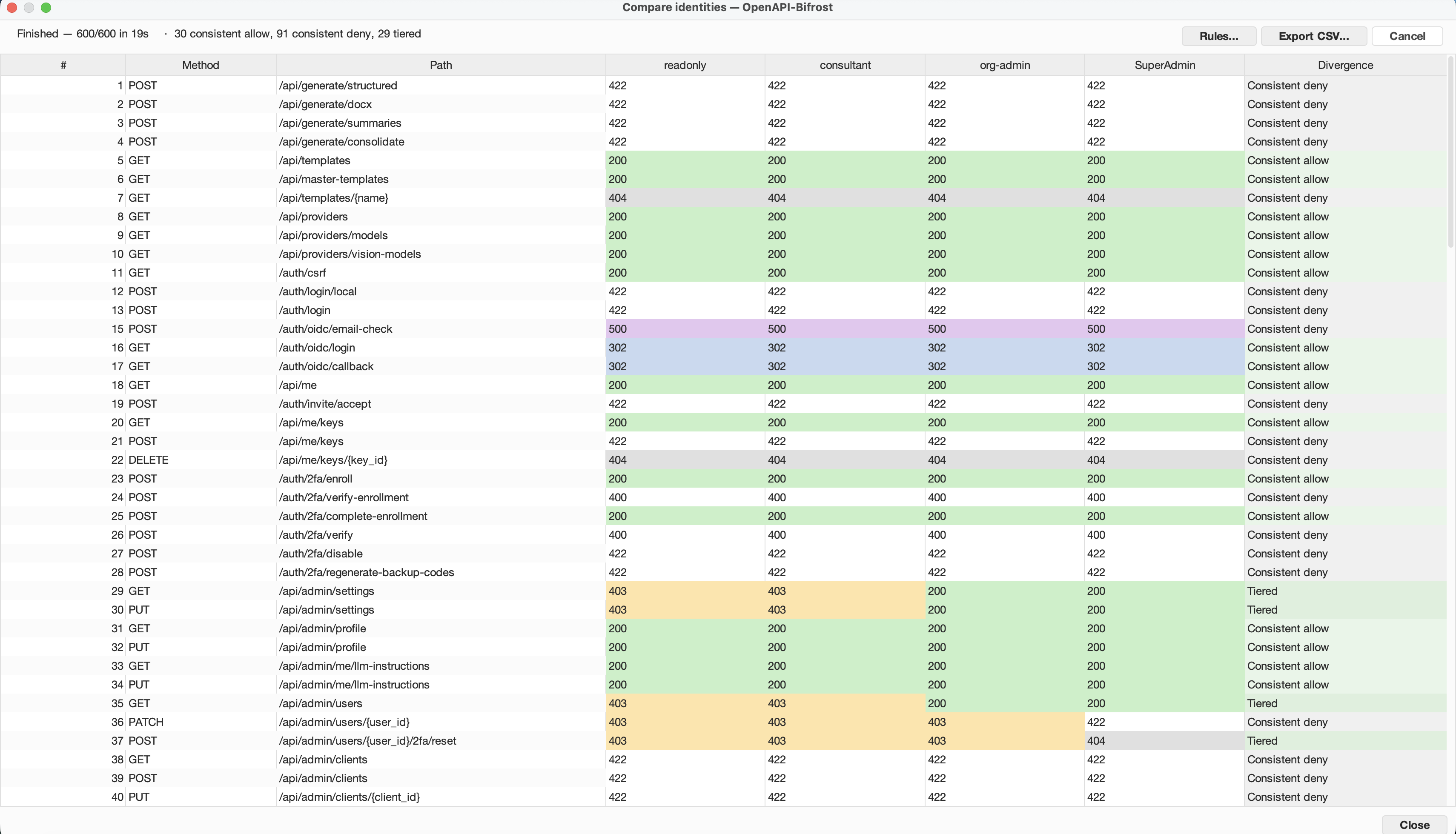
Classification uses a stack-depth model rather than a plain allow/deny split:
- Consistent allow (green) — every identity got a 2xx. Endpoint is effectively public or tiering is broken open.
- Consistent deny (grey) — every identity hit the same wall. The resource may not exist for anyone, or everyone is blocked.
- Tiered (light green) — higher-privilege identities reached further through the stack than lower-privilege ones. Healthy role separation, including subtler patterns like
403, 403, 404where only admin passed auth. - Divergent (red) — a lower-privilege identity got further than a higher-privilege one. Possible authorization inversion.
Right-click any cell to send that exact (endpoint, identity) request to Repeater. Export the full matrix to CSV — with a human-readable explanation column — for reporting. Declare tag→tier rules (e.g. Admin -> admin*) to overlay violation assessments directly in the grid and CSV.
Destructive endpoints (/logout, DELETE, /revoke, etc.) are detected before the run starts and offered for exclusion by default — firing /api/logout mid-comparison invalidates the sessions you’re testing with, which the tool gracefully refuses to do silently.
Loading a spec
Multiple ways in:
- Drag and drop a JSON/YAML file onto the drop zone.
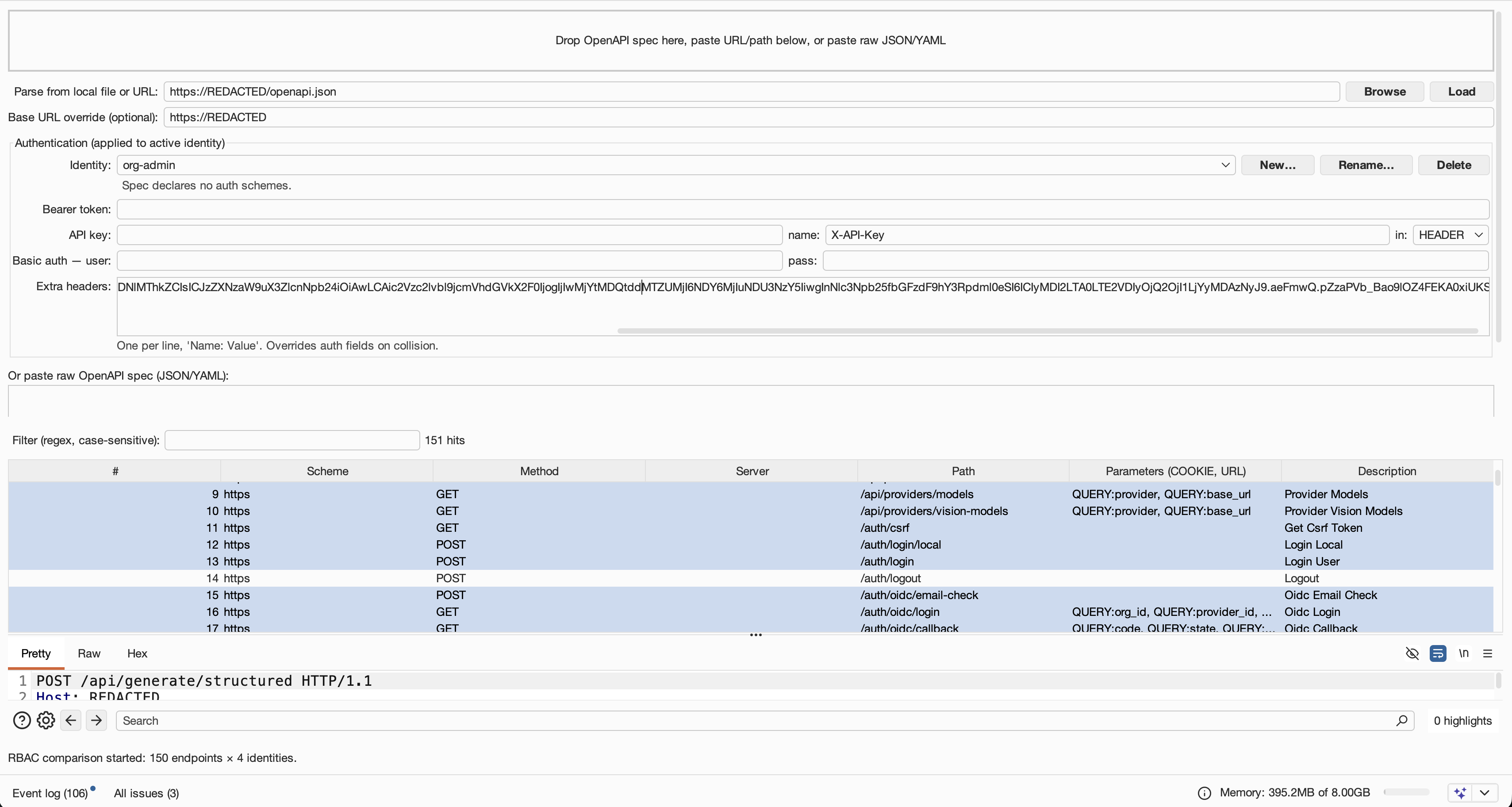
- Paste a URL or file path, optionally filling Extra Headers with any auth the spec endpoint requires, then click Load.
- Right-click any request in Proxy / Repeater / Logger → Send to OpenAPI-Bifrost. This is the fast path: host, base URL, and auth headers (cookies, bearer, API keys minus browser noise) are auto-imported. If the response body is an OpenAPI spec, it’s auto-parsed — one click from “I have a working browser session” to a parsed endpoint list. If it isn’t but the host suggests a spec (
/openapi.json,/swagger.json,/v3/api-docs), the URL field pre-fills so Load is a single click. - Paste raw spec text into the textarea and hit Parse.
When multiple identities exist, “Send to OpenAPI-Bifrost” prompts for which identity should receive the imported auth — preventing silent overwrites that were a source of false-negative RBAC results.
Supports OpenAPI 2.0 (Swagger) and OpenAPI 3.x in both JSON and YAML. Handles the common shell-prompt paste (strips leading anon@host:/$ cat openapi.json chatter). Path parameters get format-aware placeholders based on the spec’s schema: format: uuid → a real UUID, format: date-time → a valid ISO timestamp, enums use their first value, etc. Strict server-side validators therefore route the request to the auth layer instead of bouncing it at the URL-match stage.
Authentication and identities
Bifrost centres on named identities. Each identity holds:
- Bearer token (whitespace/newlines stripped automatically for multi-line JWT paste).
- API key — value, header name, and location (header / query / cookie).
- HTTP Basic — user + password.
- Extra headers — free-form textarea for anything else (
Cookie:,X-Tenant:,X-CSRF-Token:, whatever). Overrides the above on collision, so you can paste raw headers verbatim from a working request. - Base URL override — per-identity, so “admin on staging” and “user on prod” stay straight.
Switch via the dropdown in the Authentication panel; add / rename / delete named identities with the buttons alongside. Identities persist across Burp restarts via the Java preferences store.
When a spec declares components.securitySchemes, the panel shows a one-line summary and pre-fills the API key header name if exactly one apiKey scheme is declared.
Sending to Burp tools
Select one or more endpoints → right-click → OpenAPI-Bifrost →
- Actively Scan (Pro only) — sends to Scanner with your active identity’s auth. Pre-checks scope and aborts with a clear message if all selected endpoints are out of scope (Scanner otherwise silently drops them). Fires a single audit task for the whole batch.
- Send to Repeater — one tab per endpoint, named
METHOD /path. - Send to Intruder — auto-marks URL, cookie, and body parameter values as insertion points. Auth headers are not marked, so your session cookie / bearer token don’t get overwritten by fuzz payloads.
- Compare across identities… — the RBAC grid. A reorderable picker lets you choose which identities to run against and set their priority order (least-privileged at top, most at bottom). Destructive endpoints in your selection are flagged and offered for exclusion.
Ctrl+I / Cmd+I sends the selection to Intruder.
Usability details
- Sortable columns on the endpoint table — click any header.
#sorts numerically (not1, 10, 11, 2). - Regex filter (case-sensitive, capped at 500 chars to mitigate ReDoS). Live row counter.
- Live request preview updates when you select an endpoint or change auth fields, showing exactly what will be sent.
- Double-click (or Space) toggles identity inclusion in the comparison picker; single-click just selects so you can reorder with Move Up / Down without toggling as a side effect.
Installation
- Build:
./gradlew build - In Burp: Extensions → Installed → Add → Extension type: Java → select
build/libs/OpenAPI-Bifrost-1.0.jar.
Requires Burp Suite with Montoya support. Active Scan requires Burp Suite Professional; everything else (RBAC comparison, imports, Intruder, Repeater) works on Community.
Build
./gradlew build
Requires Java 17+. Runs the full JUnit 5 suite, Cucumber BDD scenarios, and JaCoCo coverage verification (80% line coverage gate on non-UI classes).
License
MIT. See LICENSE.